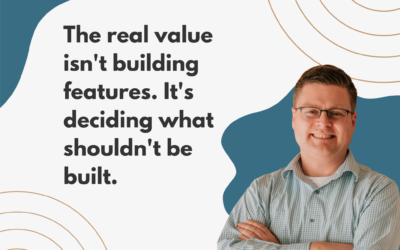
After 20 years of building software, I’ve seen projects go incredibly well… and I’ve seen them stall out, drag on, or fail spectacularly.
There are a lot of reasons software projects struggle, but one reason shows up again and again:
Overplanning.
That might sound surprising.
Because planning is important. Really important.
If you were building a skyscraper, you wouldn’t just start pouring concrete and hope it works out. You need blueprints. You need structure. You need a clear plan.
Software is no different.
You need:
- A solid understanding of requirements
- A clear architecture
- A shared vision of what you’re building
But here’s where things go wrong…
When Planning Becomes the Problem
At some point, planning stops being helpful and starts slowing everything down.
I’ve seen projects where teams spend weeks or even months trying to think through every possible feature, edge case, and future scenario before writing a meaningful line of code.
The result?
The initial version of the product becomes overloaded with “nice-to-have” features.
These extras:
- Take more time to build
- Increase costs
- Delay launch
- Add complexity
And the biggest issue?
Many of those features either don’t get used… or end up needing to be rebuilt anyway.
The Power of the MVP
This is where the idea of a Minimum Viable Product (MVP) becomes critical.
An MVP is not a half-baked product.
It is a focused product.
It includes:
- Only the features required to solve the core problem
- Only what is needed to launch
- Nothing extra
That last part is the hardest.
Because when you’re building something, ideas come fast.
“Wouldn’t it be great if it also did this?”
“Oh, we should definitely include this too.”
“What if users want this later?”
Before long, your “version 1” starts looking like version 3 or 4.
A Real-World Example
Imagine a team building a simple app to help people decide what to have for dinner.
Seems straightforward, right?
But during planning, ideas start flowing…
“What if users could filter by cuisine, dietary restrictions, cooking time, and ingredients they already have?”
“Wait, what if it also suggests wine pairings?”
“Ooh, and what if it creates a weekly meal plan automatically?”
“And… what if it integrates with local grocery stores and builds a shopping cart for you?”
At this point, the app is basically a personal chef, nutritionist, and Instacart all rolled into one.
So they build it.
Months later, it launches with dozens of features, beautiful screens, and a very impressive onboarding process.
Then they look at how people are actually using it.
Most users open the app, stare at all the options for a few seconds…
…and then type “easy chicken recipe” into the search bar.
Meanwhile, the most common feedback coming in?
“Can you just give me one good idea for dinner without making me think?”
All that time building the ultimate meal-planning ecosystem…
When users just wanted someone to say,
“Hey, tacos. You want tacos.”
Feature X was powerful.
Feature Y was tacos.
Why This Happens
The truth is, you can’t fully predict how people will use your software.
No matter how experienced you are.
No matter how much planning you do.
Real users behave differently than expected. Always.
That’s why trying to plan everything up front is not just inefficient, it’s risky.
What Works Better
The most successful projects I’ve seen follow a different approach:
- Define the core problem clearly
- Build the simplest version that solves it
- Launch as soon as possible
- Listen to real user feedback
- Iterate based on actual usage
This approach:
- Reduces risk
- Saves time and money
- Leads to better products
The Mindset Shift
Launching with an MVP can feel uncomfortable.
It can feel like:
- “This isn’t complete yet.”
- “What if people expect more?”
- “We should just add one more thing…”
But in reality, launching earlier is what gives you clarity.
It replaces guessing with real data.
It replaces assumptions with actual user behavior.
And that’s what leads to better decisions and ultimately better software.